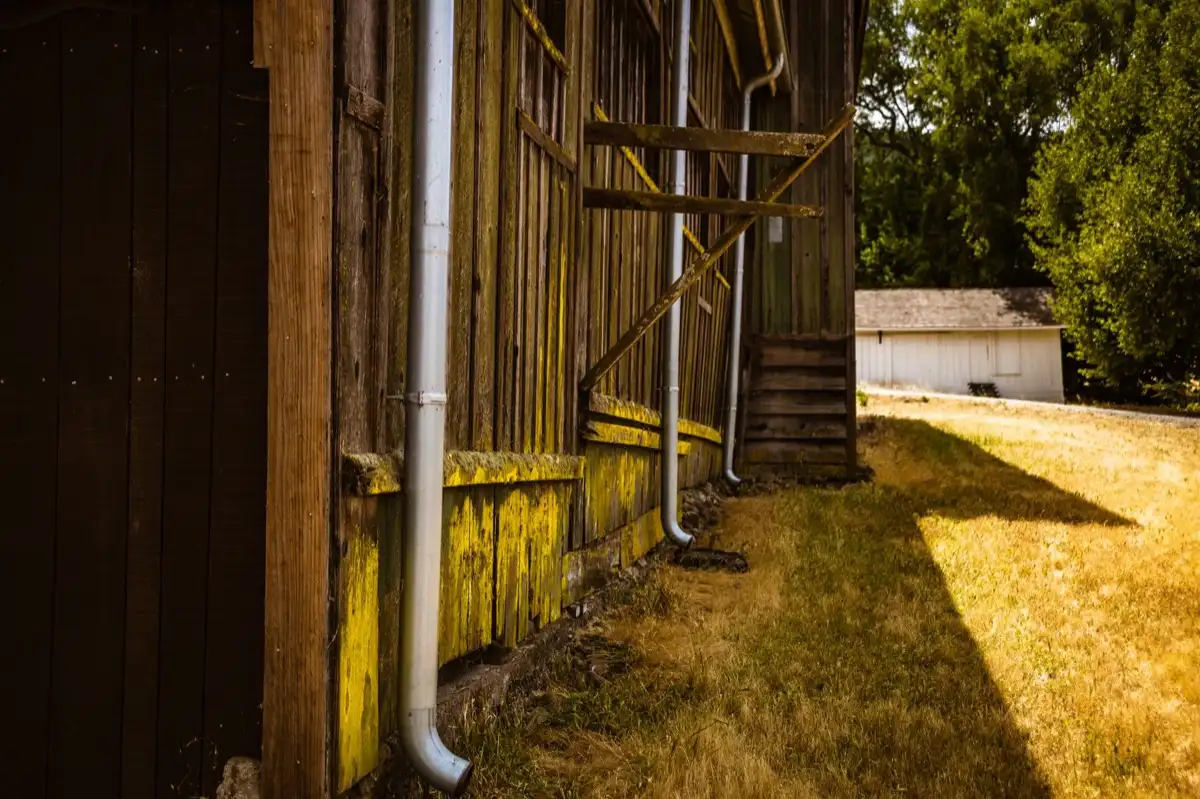
A downspout that ends at the wall is not drainage. It is a device for concentrating an entire roof plane's runoff into one spot beside your foundation, several times a year, at volume.
Everything upstream of that elbow gets argued about — profile, coil thickness, hanger spacing, seamless versus sectional — priced and compared across three bids. What happens after the water leaves is settled by a splash block from behind the garage.
The arithmetic is worth doing once. An inch of rain on 1,000 square feet of roof is about 623 gallons, and that is an ordinary storm, not a memorable one. Split between two downspouts, each delivers roughly 300 gallons. Nobody would pour 300 gallons against their own foundation deliberately.
What the code asks of roof water
This is code. IRC R401.3 requires lots to be graded to drain surface water away from foundation walls, the grade falling not fewer than six inches within the first ten feet — the section the gutter installation breakdown cites for why discharge at the wall is a defect rather than a preference. A downspout emptying inside that ten feet is putting concentrated flow into the zone the code just told the builder to slope away. Where lot lines, walls or slopes make six-in-ten impossible, the same section calls for drains or swales instead — a hint about what the water is expected to do.
The provision aimed at downspouts is R801.3: a controlled method of water disposal from roofs, discharging to the ground surface not less than five feet from foundation walls or to an approved drainage system. Check its scope before quoting it at anyone — in the model code it applies where expansive or collapsible soils are known to exist, and ICC's interpretation 14-03 reads the five feet as applying to foundation walls, not slab-on-grade. Jurisdictions amend it constantly, so your building department is the authority.
Trade rule of thumb, not code: the distances people repeat — six feet, ten feet, past the drip line — are experience. Five feet is a floor, and in flat clay it is a puddle that walks back.
Above ground: the cheap answer, and how honest it is
| Option | What it actually does | Where it fails |
|---|---|---|
| Splash block | Stops erosion under the outlet | Moves water a foot. It is not conveyance |
| Rigid extension, 4–8 ft | Hands water to grade past the backfill | Kicked, mown around, never re-seated |
| Roll-out sleeve | Unrolls under flow, retracts after | Silts, tears, lawn ornament by year three |
None of these drains anything by itself. Each is a handoff: the extension carries water past the loose backfill around the foundation — always more permeable than the ground beside it — and gives it to the grade. Where the grade slopes back toward the house, an extension buys a longer route to the same wet basement. Where the lot falls away, a rigid extension onto solid ground fixes this for the price of lunch, and everything below is an upgrade you probably do not need.
Buried pipe, and the corrugated trap
Bury the line when the lot is flat, when extensions keep getting destroyed, or when water has to travel thirty feet instead of six. Then buy the right pipe, because that choice decides whether the system is serviceable or disposable. Solid smooth-wall PVC — usually 3 or 4 inch, SDR-35 or Schedule 40 — has glued joints, a slick bore, and can be snaked or jetted end to end.
Black single-wall corrugated pipe sits in the same aisle at a fraction of the price, and underground it is a trap on four counts, with its perforated cousin adding a fifth:
- It silts. Every corrugation is a small valley, and shingle grit settles into all of them.
- It holds water permanently, because the bottom of each ripple sits below the flow line, correct slope or not.
- That water freezes. A pipe holding water in a hundred small pockets is designed to ice up.
- You cannot clear it. A snake catches the ridges. A blocked corrugated line is a trench and a Saturday.
- The perforated version is a different product entirely. Sock-wrapped French drain pipe collects groundwater out of soil rather than carrying a roof's flow across a yard. Under a downspout it irrigates everything it passes.
Published hydraulics agree with the shovel. Manning's roughness tables put single-wall corrugated around 0.021 to 0.030 against roughly 0.009 to 0.011 for smooth-wall PVC, so at equal diameter and slope the smooth pipe moves substantially more water. Dual-wall corrugated with a smooth interior tests much closer to PVC, in fairness. It is not the black stuff on the shelf.
Slope and access. An eighth of an inch of fall per foot is the working minimum and a quarter inch is better, but continuous fall matters more than either — a belly holds water permanently and catches silt that would otherwise wash through. Three fittings decide whether the line can be serviced at all: a cleanout at the top of each run, a catch basin at the downspout, and long-sweep bends rather than tight elbows.
Si prefieres que te expliquemos en español a dónde va el agua de tus bajantes y por qué está llegando a los cimientos, lo hacemos sin problema.
Where the line is allowed to end
Daylight is the one to want: the pipe emerges lower on the lot and the water leaves. It needs real fall across the yard, a guard on the outlet, and that outlet kept clear of mulch — the maintenance item everyone forgets until it backs up.
A pop-up emitter is the flat-lot answer, a spring-loaded lid that opens under pressure and shuts after. Two caveats: the box beneath it fills with silt, and it is the first thing in the system to freeze shut.
A dry well buys storage where there is nowhere downhill to send water. Size it against the volume above — 623 gallons per inch of rain per 1,000 square feet, split across the downspouts feeding it — and against soil that drains. In heavy clay a dry well is a bathtub that empties over three days: fine for one storm, useless for two.
Not onto the neighbor's ground. Concentrating roof water onto adjacent property is a live dispute in most places, on rules that vary by state and municipality. Discharge on your own lot.
Tying downspouts into the sewer
The general position is close to universal: storm water does not belong in a sanitary sewer. The International Plumbing Code says it in one line at 1101.3 — storm water shall not be drained into sewers intended for sewage only — and the reason is arithmetic, not principle. Roof water arriving at a treatment plant mid-storm displaces capacity meant for sewage, and in combined-sewer cities it causes overflows into the nearest river.
Which makes it an enforcement issue in exactly the housing stock where you find it. Older neighborhoods have downspouts plumbed into the house drain, done legally at the time, and combined-sewer cities run disconnection programs, point-of-sale inspections, stormwater surcharges and deadlines with penalties.
The specifics are genuinely local — the code edition in force, whether yours is grandfathered, whether disconnecting earns a rebate, who inspects it. The authority is your water utility or building department. Anyone quoting a national rule here, online or on your porch, is guessing about your street.
Winter is where the design gets tested
The failure sequence is boringly consistent. The outlet freezes first, being the most exposed few feet of the run. A plugged outlet backs water up the line, a full line backs into the downspout, and a full downspout leaves the gutter nowhere to drain — so it holds water, and water held through a freeze becomes weight, then ice, then a hanger pulling out of the fascia.
What survives cold is a line with continuous fall that empties itself between storms, an outlet kept clear, and a bore with nothing in it to hold a pocket of water — the corrugated argument from another direction, since a hundred small reservoirs is a hundred places for ice to start.
Where the ground freezes deep, run the line below local frost depth to a daylight outlet, or accept that it will freeze and fit a removable elbow at the top so the downspout can come off the buried line and onto a surface extension for the season. Frost depth varies enormously, so that number comes from the building department, not a national chart.
Who is allowed to dig this in New Mexico
Downspout drainage falls between trades. The gutter contractor stops at the elbow, the landscaper starts at the trench, and the job is small enough to sit near whatever threshold, if any, your state applies.
The roofing classification here is GS-21, issued by the Construction Industries Division, and it takes two years of foreman-level trade experience to hold one. A GB-98 general building license covers roofing as well, so either number is a legitimate answer when you ask. The handyman exemption people cite is seven thousand two hundred dollars of compensation a YEAR in aggregate, not per project, which is a far smaller loophole than it sounds.
Whether a credential covers this particular work is a fair question to ask out loud before anyone opens a trench across the yard.
If a winter water loss turns into a claim in New Mexico
Backed-up drainage produces exactly the damage an insurer is most likely to refuse, on the grounds that the water arrived through neglect rather than weather. If that refusal turns up after you have already signed with somebody to do the work, the room you have left is a question of state law, and less uniform than a doorstep pitch implies.
New Mexico gives you no cancellation right tied to an insurer denying your claim. The roofing content that says otherwise is Texas or Colorado copy with the state name changed. Your real protection is narrower and comes from the door-to-door sales law: three business days from signing, and only where the seller came to you rather than the other way round.
What to put in a drainage scope
| Line item | What to require in writing |
|---|---|
| Pipe | Solid smooth-wall PVC, diameter stated. Not corrugated, not perforated |
| Slope | Fall per foot, continuous, no bellies |
| Length | Feet of buried run, and the discharge point |
| Termination | Daylight, pop-up emitter or dry well, named |
| Access | Cleanout at the top of each run; catch basin, or excluded in writing |
| Depth | Stated, against local frost depth |
| Restoration | Who closes the trench and reseeds |
Bottom line
The gutter is the part you look at. The discharge decides whether roof water becomes a foundation problem. Get it past the graded zone, use solid smooth-wall pipe underground, give the line continuous fall and a way to be cleaned, and end it on your own lot where the ground already drains. Then stand outside during the next real storm and watch what your downspouts actually do, which is the one inspection that never lies.
Las Cruces Premium Roofing follows roof water to its discharge point in Las Cruces and the Mesilla Valley — outlet count, downspout sizing, buried line, where it daylights — with storm damage restoration and roof inspections when the trail leads back up. Call (833) 670-8616 and we will walk the line with you.
Ready for a free quote in Las Cruces?
Las Cruces Premium Roofing — free estimate, clear scope, no pressure. Use the form on this page or jump to the homepage quote.
Related services in Las Cruces
Las Cruces Premium Roofing money pages — go straight to the service you need.
- Roof Leak Detection & Repair →
A leak in the Mesilla Valley hides for a season. The Las Cruces normal is 9.74 inches of precipitation a year, and only about 24.5 days carry a tenth of an inch or more, so a hole waits weeks between tests.
- Storm Damage Restoration →
Storms here arrive as wind and blowing grit far more often than as water. The Mesilla Valley spends March through May under long westerly blows, and the damage they leave behind is a fastener problem rather than a flood.
- Roof Inspections & Core Cuts →
An inspection here has to answer a legal question, not just a condition question. New Mexico's residential code decides in advance whether your next roof can go over the old one, and the answer sits under your feet in the form of layer count.
- Roof Replacement & Recover →
Two roofs sit side by side across Dona Ana County and they are not the same product. One is a framed deck you can tear to sheathing.
- Hail Damage Assessment →
Most of what gets called hail damage in Dona Ana County is not hail. That sentence is unpopular in this trade, and it belongs here at the top rather than in a conversation after you have already filed a claim that cannot win.
Frequently asked questions
How far from the foundation should a downspout discharge?
Far enough that the water lands on ground already sloping away from the house, which means past the graded zone rather than at a magic number.
The IRC asks for the grade to fall not fewer than six inches within the first ten feet, and where a controlled method of roof water disposal is required it names five feet from foundation walls as the minimum. Five feet is a floor, not a target.
On a flat lot, in heavy clay, or anywhere the ground has settled back toward the house, the honest answer is longer, because the extension is only handing water to the grade that does the real work.
Can I bury a downspout with the black flexible corrugated pipe?
You can, and it is sold beside the downspouts for exactly that reason, but it is the wrong pipe underground. Every corrugation is a small valley that holds silt and standing water even when the line is sloped correctly, and that water freezes.
You also cannot run a drain snake or a jetter through single-wall corrugated pipe without wrecking it, so a blockage is not a service call, it is a trench. Solid smooth-wall PVC costs more per foot and can still be cleared in twenty years.
What slope does an underground downspout drain need?
The working trade minimum is an eighth of an inch of fall per foot, and a quarter inch per foot is better where the yard has the drop. What matters more than the number is that the fall is continuous.
A line that averages the right slope but dips in the middle has a belly, the belly holds water permanently, and the silt arriving with every storm settles in exactly that spot. Treat slope as the rule of thumb it is, and check what your own building department requires.
How do you unclog a buried downspout drain?
If it is smooth-wall PVC with a cleanout, you snake or jet it from the cleanout and it takes an hour. If it is corrugated pipe with no access point, you dig. That difference is the whole argument for the more expensive pipe, and it is invisible on installation day, which is why the cheaper option keeps winning.
A catch basin at the base of the downspout helps too: grit drops into a sump you can empty instead of traveling down the line.
Can downspouts be connected to the sewer?
Not to a sanitary sewer, in most jurisdictions. The International Plumbing Code puts it in six words at section 1101.3 - storm water shall not be drained into sewers intended for sewage only - and older cities with combined systems run active disconnection programs because roof water overwhelms treatment plants during storms.
Plenty of older houses have exactly this connection, done legally when it was built. Deadlines, penalties and whether yours is grandfathered are strictly local, so the authority is your municipal utility, not a national rule.
Will a buried downspout line freeze in winter?
The outlet freezes first, because the last few feet of pipe are the most exposed part of the run, and a plugged outlet backs water up the line. Once the line is full the downspout is full, and once the downspout is full the gutter has nowhere to drain.
That is how a drainage decision made in July turns into a gutter carrying ice in January. Continuous fall so the line empties itself, an outlet kept clear, and a bore with no corrugations to hold water are what keep it working cold.
Local context
How this applies in Las Cruces, NM
Every article here is written from roofing work done in Las Cruces and the Mesilla Valley, so the numbers reflect local labour, permit and material costs rather than a national average. Your own job can land either side of them depending on access, the condition of what is already there, and the materials you pick — HUD-code roof pans re-seamed with embedded reinforcing fabric, silicone restoration membrane applied at 22 to 26 dry mils, roof-mounted evaporative cooler curbs with base and counter flashing.
The way to turn any of this into a real answer is to have someone look at your actual situation. The free estimate is free, itemized and written down, with no deposit and no obligation. Call (833) 670-8616 or start on the Las Cruces Premium Roofing homepage.
Areas Las Cruces Premium Roofing covers
Las Cruces first, then the surrounding communities of the Mesilla Valley. Each has its own page with local detail rather than a copy of this one:
- Sunland Park, NM — Dona Ana County, population 16,702
- Chaparral, NM — Dona Ana County, population 16,551
- Anthony, NM — Dona Ana County, population 8,693
- Santa Teresa, NM — Dona Ana County, population 5,044
- University Park, NM — Dona Ana County, population 3,007
- Vado, NM — Dona Ana County, population 2,930
Or jump to the full list of Las Cruces services.
More from the Las Cruces Premium Roofing blog
- Cost to Fix a Leak in a Roof in Las Cruces: What Actually Moves the Number
A roof leak is a category, not a job. What separates a half-hour repair from a two-day one in Las Cruces, NM, and why no published range can price your roof.
- Cost for Gutter Installation in Las Cruces: Priced by the Foot
Gutters are quoted per linear foot, and the foot price hides most of the job. What moves a gutter bid in Las Cruces, NM, and what a bad install costs later.
- Can You Claim a New Roof on Your Taxes? Usually No — Here's What People Actually Mean
A roof on your own home is not deductible. It adds to your basis, which matters when you sell.
The Las Cruces Premium Roofing Team
roofing specialists serving Las Cruces, NM
Written by the Las Cruces Premium Roofing team — insured roofing pros serving Las Cruces, NM and the surrounding area.